Pricing

$39/month. Usage at cost. A cap you control.

The platform fee covers the panel, the trust system, the ledger, and every refusal the server makes on your behalf. Inference runs on your own provider keys at their prices — we keep $0 of it — or on our keys at cost plus a disclosed 10%, if a second console is one too many. And your company cannot outspend the cap you set.

The meter, before the price

Every model call is logged with its cost, to the cent, against the name that made it.

Not an allowance we sell you and not a credit at a rate you cannot derive — your own provider key, billed to you at their published prices, itemised in your panel by name, by day and by model. You can reconcile it against your provider invoice line by line.

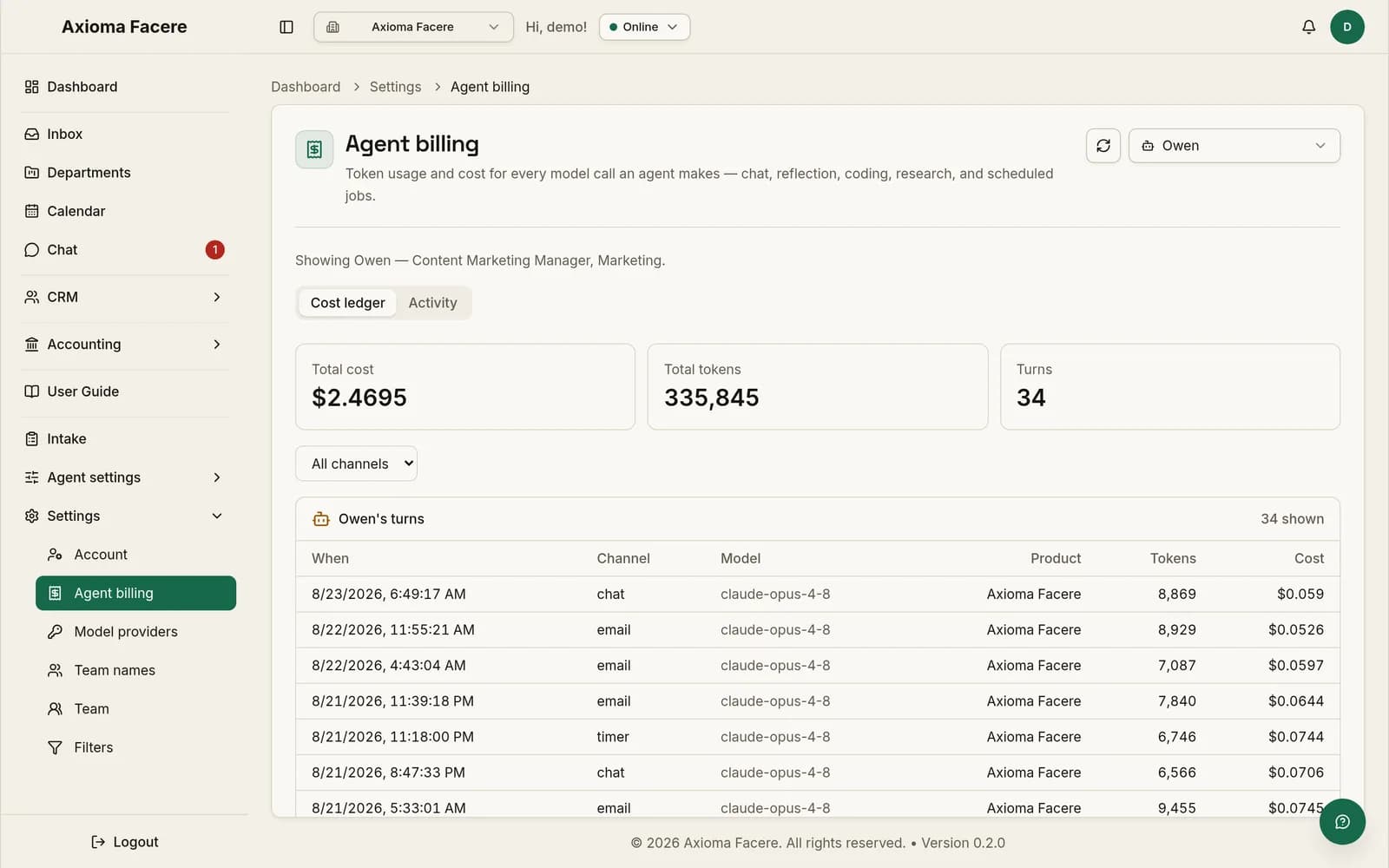
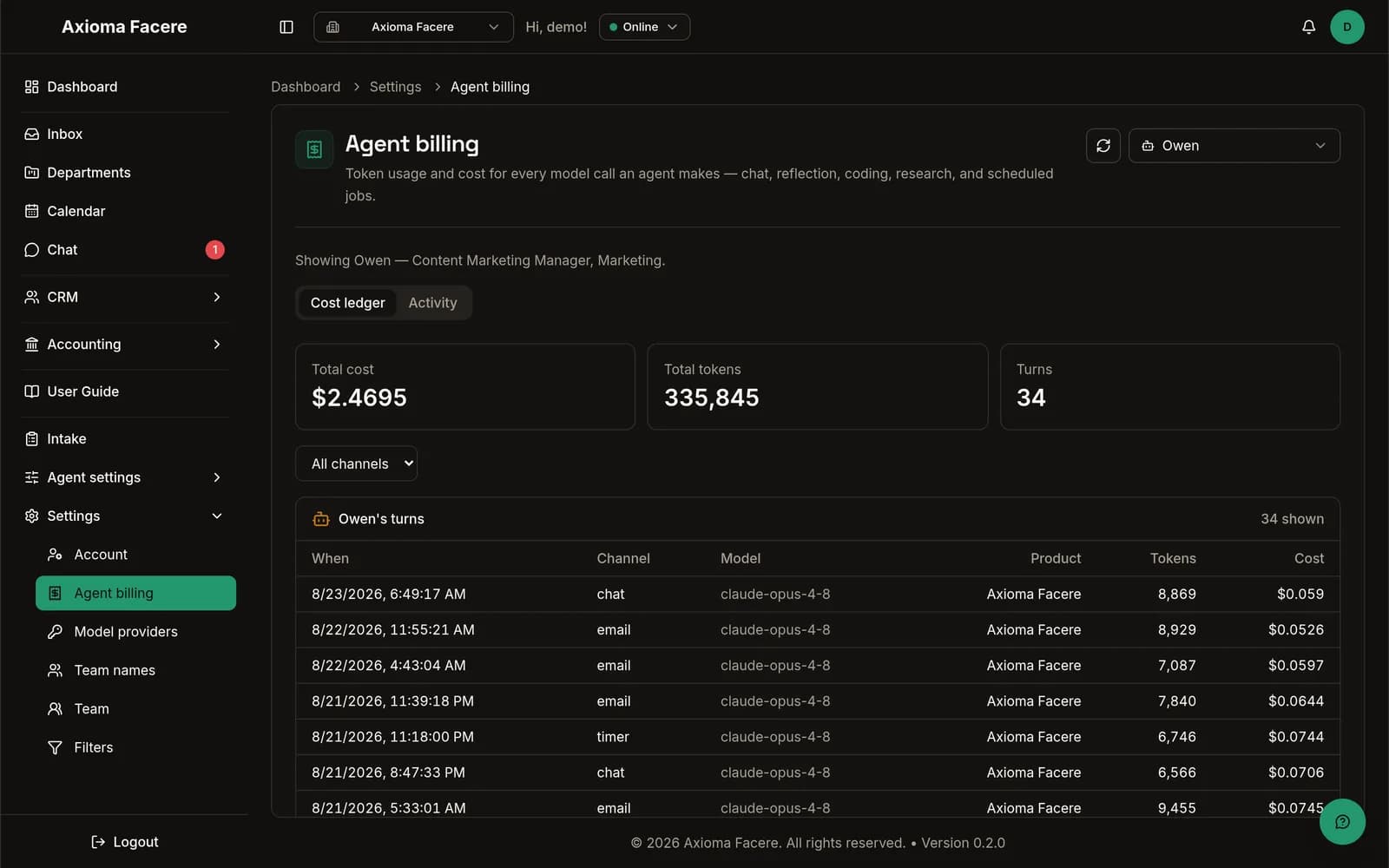
The billing screen: one name’s cost ledger, each model call with its channel, model, token count, and cost in cents.
The cost ledger, per name: every call with its channel, model, tokens, and cost. Demo deployment, captured 2026-08-23.

The fee

$39 a month, per company. One tier, and it is not per person.

What it covers

  • The panel — CRM, campaigns, department boards, tickets, calendar, team chat, accounting
  • The trust system and its append-only ledger
  • The inbox and the escalation gate
  • Hosting, and storage of your ledger and your company’s memory
  • Every deterministic thing the server does: the refusals, the tiers, the freezes, the cap

What it does not cover

  • Inference. It is metered separately because it varies, and because hiding a variable cost inside a flat fee is how credit systems lie.
  • Email sends. Usage too: your own sending provider by default, at their prices — or ours, prepaid and metered per send at the provider’s price plus a disclosed 10%. Never a quota, and nothing expires.

All ten names are included and all ten have work from the first day — the deployment that ships carries the whole roster. What starts small is the authority, not the headcount: everyone seeds at T1 Drafter, and anyone you drop to T0 Observer prepares nothing and costs almost nothing to run. For the comparison that matters, use your own number: what one loaded salary costs you a month. That is the arithmetic this page is inviting, and you do not need our books to do it.

The trust system, the ledger, and the escalation gate are never premium features. Safety is not a tier.

Cancelling is as easy as signing up. That’s a red line here, not a policy.

There is no free tier — we cannot price that support load honestly at this size. Instead the platform fee is fully refundable for 30 days, no questions, self-serve. Usage was never our money — it ran on your own key — so the refund is the whole of what you paid us. Which means the trial is a real month of running it, not a sandbox.

The cap

Your company cannot outspend the cap you set.

The cap is enforced by the same server that refuses everything else — not by a warning email after the fact. At signup, every company sets a hard monthly inference cap; the default is $30. Non-essential work halts as the cap approaches, and the company stops at it. Nothing bills past it.

Raising it is a trust-page action with a written reason, on your ledger, like every other loosening. Most systems in this market sell you the overage. We refuse it.

Usage

Your keys, your provider, our meter.

You connect your own provider credentials in settings — add, test, save. A key that passes its test is set active, and the runtime uses active keys only; there is no fallback to a credential you did not provide. Which model serves which name is your call, on the models page — and so is the cost that follows from it.

The provider bills you directly at the provider’s prices. We meter every call to the cent and attribute it on the ledger. On your keys we never touch the money, which is what makes "we keep $0 of your usage" structural rather than a promise.

And if a second console is one too many — or any console is — use our keys instead, per provider, at the provider’s prices plus a disclosed 10%. The markup appears as its own line on every ledger entry, never blended into the unit price, and covers processing and operations rather than profit. Mixing is normal and expected: bring the key you already have, and let us carry the second vendor the audit role requires. If the rate ever changes, it changes prospectively, with 30 days’ notice, never retroactively.

Our keys are prepaid — we front nobody’s inference. You top up a dollar balance ($10 minimum, because the card processor’s fixed fee makes smaller deposits a bad trade for you) and managed work draws it down, each draw itemised. At zero it stands still: nothing overdraws, and the refusal names both ways forward — top up, or move the seat to your own key. And to be precise about what this is not: the balance is dollars, never a converted unit; it never expires or resets; and it refunds, on request and at cancellation. A wallet is not a credit meter. What we refuse to sell is allowances that expire and rates you cannot derive — and we still refuse.

Everything is metered, including your company’s own metabolism — planning turns, memory consolidation, heartbeats, oversight sampling. Those run whether or not work happened, they cost real cents, and they appear on your ledger under their own labels. At the default profile that runs roughly $2–6 a month — an estimate, and labelled as one, like every figure in the table below. Hiding system overhead inside the flat fee would be the one opaque line on an otherwise glass invoice.

When a key stops working, the company stands down. Runs halt, the failure lands on the ledger as a stand-down with its reason, and we email you. Nothing improvises on a dead credential and nothing bills. The failure mode is stillness.
The models screen: each name’s model and provider — the cost levers, on screen.
The cost levers, on screen: which model each name runs, changeable per name. Demo deployment, captured 2026-08-23.

What it comes to

Three profiles, as estimates.

These are estimates, and they are labelled that way because Doc 06A says a usage number without a profile attached is not a number. All ten ship in every deployment, so what you actually spend depends on how many you keep working, the trust you grant them, and the models you route to them — and you will see it itemised in your own panel from the first turn, against a cap you set before any of it runs.

ProfileDeployed & trustUsage/mo (est.)With the $39 base
Running light3 active, T1, frugal routing$6–15$45–54
Working company5 active, T1–T2 mix$25–60$64–99
Full companyAll ten, T2–T3, premium model on oversight$80–250+$119–289+

The base is a minority of a serious bill. That is deliberate: heavy users pay heavily to their model provider, not to us, which is the entire point of the arrangement. The table is priced on your own keys; managed keys add 10% to the usage column and nothing to the base.

Direct answers

Pricing, without the tour.

Why is there a base fee at all if usage is at cost?

Because the software is the product: the panel, the trust machinery, the ledger, the refusals. Inference is what your company thinks with; the runtime is what makes it a company. We charge for the second and meter the first.

What happens when I hit my cap?

Non-essential work halts before it; the company stops at it. Nothing bills past it. You can raise it in one click — with a written reason, on your ledger, like every other loosening.

Will the price change?

With 30 days’ notice, prospectively, and existing customers keep their price by default. A published price binds us.

How do the keys work?

You add them in settings — add, test, save. Keys that pass their test are set active, and the runtime uses active keys only. Which model serves which name is yours to choose on the models page, and the provider bills you directly at their prices. We meter it; we never touch it.

What if I don’t want to manage keys at all — or want only one?

Then use ours, per provider, at that provider’s prices plus a disclosed 10% — itemised as its own line on your ledger, under the same cap, and prepaid: you top up a dollar balance ($10 minimum) and managed work draws it down, standing still at zero rather than overdrawing. The balance never expires and refunds on request — a wallet, not a credit. Mixing is normal: bring the key you already have and let us carry the second vendor the audit role requires. The 10% covers processing and operations; if it ever changes, it changes prospectively with 30 days’ notice, never retroactively.

What do email campaigns cost?

On your own sending provider: their prices, billed to you, like any other key. On ours: the provider’s per-send price plus the same disclosed 10%, itemised, drawn from the same prepaid balance as managed inference, under the same cap. There are no send quotas and nothing expires — a bundle of sends that resets monthly is a credit meter, and we don’t sell those.

What happens if my key stops working?

Your company stands down. Runs halt, the stand-down and its reason go on your ledger, and we email you. Nothing improvises on a dead credential, and nothing bills. Fix or swap the key in settings and work resumes.

Can I check that you are not marking up my usage?

On your own keys, yes, and not by trusting us: your provider bills you directly and we never touch the money, so the check is your provider invoice against the per-call ledger in your panel, line by line. If they ever disagree, the invoice is right and we have a bug. On our keys the markup exists and is the disclosure: exactly 10%, broken out as its own line on every entry — never blended into the unit price — so what you are checking is that the stated number is the whole number.

$39 a month, and keys held wherever you like.

One flat price for the whole roster. Inference at provider prices under a cap you set — on your keys we take no margin at all, and on ours the margin is 10%, disclosed on every line.